Arbitrage Algorithms: Detecting Spreads Across Crypto Exchanges

Financial Disclaimer - Educational Content Only
This content is for educational and academic purposes only. It presents theoretical and mathematical concepts for understanding financial market mechanics. This is NOT financial, investment, or trading advice. The code examples, formulas, and strategies discussed are presented for educational understanding only and should NOT be used for actual trading or investment purposes. Trading cryptocurrencies and other financial instruments involves substantial risk of loss, including the possibility of losing your entire investment. Past performance is not indicative of future results. The mathematical models and algorithms discussed are theoretical and may not perform as described in real market conditions. Always conduct your own research and consult with a qualified financial advisor before making any investment decisions. The author and D613 Labs are not responsible for any financial losses incurred from following, implementing, or attempting to use any information, code, or strategies discussed in this content.
Arbitrage Algorithms: Detecting Spreads Across Crypto Exchanges
1. Introduction: The Thermodynamic Inefficiency of Markets
Imagine a closed system where energy distribution is non-uniform. In thermodynamics, entropy dictates that energy will flow from high concentration to low concentration until equilibrium is reached. Financial markets operate under similar physical laws, yet they are perpetually kept out of equilibrium by information asymmetry, latency, and fragmentation.
For the quantitative engineer, the cryptocurrency market represents a unique anomaly in modern finance. Unlike the centralized architecture of the New York Stock Exchange (NYSE), where a National Best Bid and Offer (NBBO) is federally mandated, crypto markets are decentralized and fragmented. Bitcoin (BTC) trades on Binance, Kraken, Coinbase, and hundreds of other venues simultaneously, often at slightly different price points due to liquidity variance and geographic latency.
Here lies the engineering challenge: The Synchronization Problem.
How do you observe the state of multiple, disjointed systems (exchanges) simultaneously, identify a discrepancy (a spread) that exceeds the friction coefficients (trading fees and withdrawal costs), and execute a rebalancing act (the trade) faster than the speed of information propagation across the network?
This is not merely a financial problem; it is a problem of signal processing and low-latency systems engineering. As an Applied Physicist, I view arbitrage not as "trading," but as the mechanical act of forcing a system toward equilibrium while capturing the energy released during that transition as profit. The "energy" here is the price spread.
In this educational deep dive, we will explore the mathematical foundations of spatial arbitrage from an applied physics perspective. We will examine the theoretical principles behind spread detection algorithms, analyze the mathematical models used in high-frequency trading systems, and discuss the advanced optimization techniques employed by institutional trading firms. This article presents these concepts for academic understanding and educational purposes only.
2. Theoretical Foundation: The Physics of Price Disparity
To build an effective algorithm, we must first define the boundary conditions of our system. In classical economics, the Law of One Price (LOOP) states that in an efficient market, identical goods must have only one price. If a deviation occurs, arbitrageurs will buy the asset in the cheaper market and sell it in the expensive one, driving the prices back to parity.
However, in the physical world, we deal with Relativistic constraints. Information cannot travel faster than the speed of light (). In digital markets, this limit manifests as network latency ().
The Arbitrage Inequality
An arbitrage opportunity exists if and only if the following inequality holds true:
Where:
- is the highest price a buyer is willing to pay on Exchange B.
- is the lowest price a seller is willing to accept on Exchange A.
- and are the taker fees on the respective exchanges (typically 0.1% to 0.25%).
- represents transfer costs (gas fees) if the strategy involves moving assets, though most HFT strategies rely on pre-funded inventory to avoid this slow step.
Graph Theory and Market Topology
While this article focuses on Spatial Arbitrage (Exchange A vs. Exchange B), it is vital to understand that the market can be modeled as a directed graph , where represents assets (BTC, ETH, USD) and represents the trading pairs connecting them. The weight of an edge corresponds to the exchange rate.
finding the most profitable path in Triangular Arbitrage (e.g., USD -> BTC -> ETH -> USD) is mathematically equivalent to finding a negative cycle in a weighted graph. We typically employ the Bellman-Ford algorithm or the Floyd-Warshall algorithm to detect these cycles.
For Spatial Arbitrage, our topology is simpler but our time constraints are stricter. We are looking for disjoint nodes and where the scalar values differ.
The Latency Delta
The probability of a successful trade execution, , is inversely proportional to the time delta between observation and execution:
If exceeds the market's coherence time (the time it takes for other bots to close the gap), the arbitrage fails. Therefore, our code must prioritize asynchronous execution and minimize computational overhead. We are essentially fighting against the "Heisenberg Uncertainty Principle" of markets: by the time you observe the price and send an order, the price may have already changed.
3. Algorithmic Concepts: Understanding Detection Systems
From a systems engineering perspective, arbitrage detection systems operate on principles of parallel data processing and asynchronous computation. The theoretical architecture involves several key components that we can analyze mathematically.
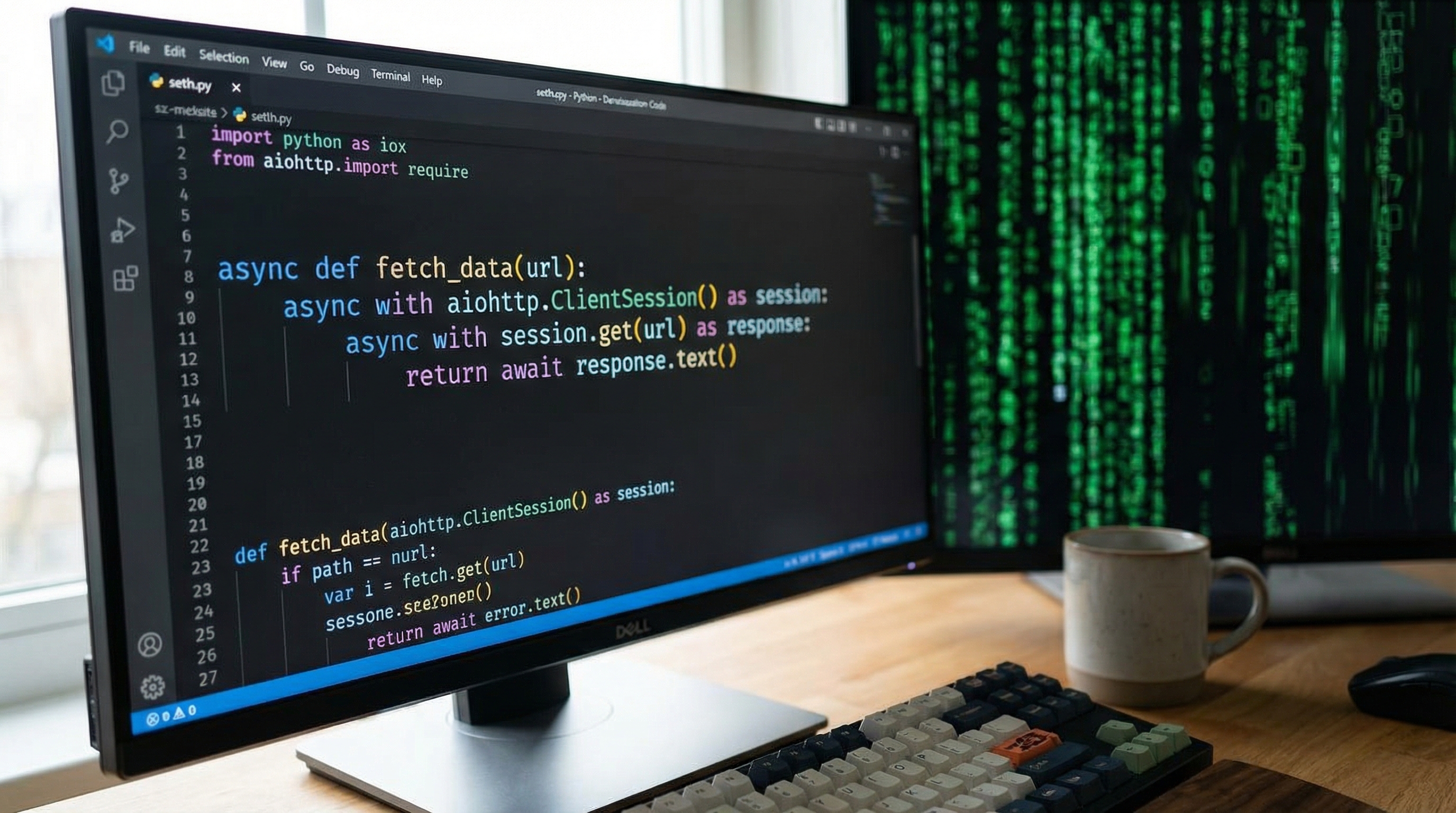
3.1 Asynchronous Data Collection Architecture
In theoretical system design, arbitrage detection requires simultaneous observation of multiple data sources. The mathematical challenge is minimizing the total observation time :
Where represents the latency to fetch data from exchange . Sequential processing would yield:
While parallel processing achieves:
This is a fundamental principle in distributed systems theory: parallel I/O operations reduce total latency by the factor of the slowest operation, not the sum of all operations.
3.2 Spread Detection Algorithm Theory
The mathematical process of detecting arbitrage opportunities involves comparing all pairs of exchanges. For exchanges, this requires comparisons, which is complexity.
The theoretical spread calculation for a pair can be expressed as:
Where:
- is the highest bid price on exchange
- is the lowest ask price on exchange
- are fee rates (typically 0.1% to 0.25%)
- represents transfer costs
An arbitrage opportunity exists when .
3.3 Depth-Weighted Price Calculation
In theoretical market microstructure analysis, executing at the top-of-book price can be misleading due to "slippage"—the phenomenon where large orders move the price. The depth-weighted average price accounts for order book liquidity:

Where and represent the price and volume at level of the order book, and is the number of levels required to fill the target volume.
This mathematical model prevents false arbitrage signals that would disappear when attempting to execute large orders.
3.4 System Architecture Concepts
From a computer science perspective, arbitrage detection systems typically employ:
- Asynchronous I/O: Non-blocking network requests to multiple exchanges
- Event-driven architecture: Real-time processing of market data updates
- State management: Maintaining local order book snapshots
- Latency optimization: Minimizing computational overhead between data collection and analysis
These are standard patterns in high-performance distributed systems, applied to the specific domain of financial market data processing.
4. Advanced Techniques & Optimization Theory
From a systems engineering perspective, high-frequency trading systems employ several optimization techniques that can be analyzed theoretically.
4.1 WebSockets vs. REST Polling: Latency Analysis
In theoretical network architecture, REST API polling introduces periodic latency. Each poll requires a round-trip time (RTT). If polling every second, the maximum observation delay is second plus RTT.
WebSocket (WSS) connections provide push-based updates, reducing latency to:
Where is the time to process the update message. This can reduce in our latency equation by orders of magnitude.
Advanced systems maintain a local "Shadow Order Book" updated via WSS deltas, allowing memory-based queries rather than network requests. This is a standard pattern in real-time distributed systems.
4.2 Colocation and Network Physics
The speed of light in fiber optics is approximately . For a round trip between Virginia (AWS us-east-1) and Tokyo (Binance servers), the theoretical minimum latency is:
Where is the distance and .
Theoretical Optimization Approaches:
- Colocation: Hosting computational resources in the same data center as the exchange matching engine eliminates network latency.
- Cross-connects: Direct physical connections between systems reduce routing overhead.
- Language Selection: Lower-level languages (C++, Rust) minimize by avoiding garbage collection pauses that can introduce microsecond-level stutters.
4.3 Inventory Management Theory
From a theoretical perspective, transferring assets between exchanges introduces significant latency (minutes for Bitcoin, seconds for faster blockchains). This violates the time constraint in our arbitrage inequality.
Theoretical Solution Model:
- Maintain pre-funded balances on multiple exchanges
- Execute trades simultaneously on both sides
- Rebalance inventory during low-volatility periods
This is mathematically equivalent to maintaining a distributed inventory state, a common pattern in distributed systems theory.
5. Real-World Applications: Industry Context
The mathematical principles and algorithmic concepts discussed here underpin critical infrastructure in modern financial markets. Understanding these systems from an academic perspective provides insight into how market efficiency is maintained.
Market Making
Market makers are essentially passive arbitrageurs. They quote both buy and sell prices. When the market moves on a primary exchange (like Binance), market makers immediately adjust their quotes on smaller exchanges to avoid being "picked off" by arbitrage bots. They use the exact detection algorithms described above to calculate the "Fair Value" price.
DeFi Liquidations
In Decentralized Finance (DeFi), protocols like Aave or Compound allow users to borrow against collateral. If the value of the collateral drops, it must be liquidated. Arbitrage bots monitor these smart contracts and the external price feeds (Oracles). When a liquidation threshold is crossed, the bot executes a transaction to liquidate the loan and capture a liquidation bonus. This is "Atomic Arbitrage"—the trade either succeeds completely or fails completely within a single blockchain block, removing counterparty risk.
Cross-Border Remittance
Companies like Ripple use arbitrage mechanics to facilitate cross-border payments. By detecting the best path from USD -> XRP -> EUR, they effectively arbitrage the forex spread to provide cheaper international transfers than traditional SWIFT banking rails.
6. External Reference: "Crypto Arbitrage Strategies"
The video "Crypto Arbitrage Strategies" serves as an excellent visual companion to this text. It typically breaks down the three primary categories: Spatial (which we covered), Triangular, and Convergence (Futures vs. Spot).
The video is particularly valuable for its visual explanation of Triangular Arbitrage within a single exchange (e.g., buying BTC with USDT, selling BTC for ETH, then selling ETH back to USDT). It reinforces the graph theory concepts mentioned earlier, visualizing the "negative cycle" detection.
Furthermore, the video often highlights the "Risks" section, which is crucial. It visualizes execution risk—what happens when one leg of your trade fills but the other doesn't. This "hanging leg" scenario transforms a risk-free arbitrage into a directional bet, which is the quickest way for a quant algorithm to lose money. The video underscores the importance of "Fill or Kill" (FOK) or "Immediate or Cancel" (IOC) order types, which we simulated in our logic via inventory management.
7. Conclusion: Understanding Market Mechanics
Arbitrage mechanisms serve as the immune system of financial markets, identifying inefficiencies and driving prices toward equilibrium. We have explored the thermodynamic principles underlying price convergence, the mathematical inequalities that define arbitrage opportunities, and the theoretical foundations of detection algorithms.
Key Theoretical Concepts:
- Latency Optimization: Asynchronous I/O, WebSockets, and colocation reduce in the latency equation.
- Liquidity Analysis: Depth-weighted price calculations account for order book structure and prevent false signals.
- Inventory Management: Distributed inventory models enable simultaneous execution without asset transfers.
Academic Perspective
From an applied physics standpoint, arbitrage represents a thermodynamic process where price differences (energy gradients) drive capital flows (energy transfer) until equilibrium is reached. The mathematical models we've discussed provide a framework for understanding how these systems operate in theory.
Further Reading & Academic References
Textbooks:
- Quantitative Trading by Ernest P. Chan - Academic analysis of trading strategies
- Algorithmic Trading and DMA by Barry Johnson - Technical market microstructure
- Market Microstructure Theory by Maureen O'Hara - Theoretical foundations
Research Papers:
- Academic studies on market efficiency and arbitrage
- Research on high-frequency trading and market microstructure
- Papers on distributed systems in financial markets
This article has presented these concepts for educational and academic understanding only. The mathematical models and algorithmic principles discussed are theoretical and should not be used for actual trading or investment purposes.
Algorithmic Trading – Machine Learning & Quant Strategies Course with Python
A comprehensive course on algorithmic trading strategies including arbitrage detection, machine learning applications, and quantitative trading techniques in Python.