Beyond OCR: How Computer Vision Identifies Kosher Ingredients
Health & Dietary Disclaimer
This content is for educational and informational purposes only. It is not intended as medical, health, or dietary advice. Dietary requirements, including kosher certification, may vary based on individual circumstances, religious interpretations, and regional standards. Always consult with qualified religious authorities, healthcare professionals, or certified kosher organizations for guidance on dietary compliance. The author and D613 Labs are not responsible for any health or dietary consequences resulting from the use of information or tools discussed in this content.
Introduction: The Entropy of the Supermarket Aisle
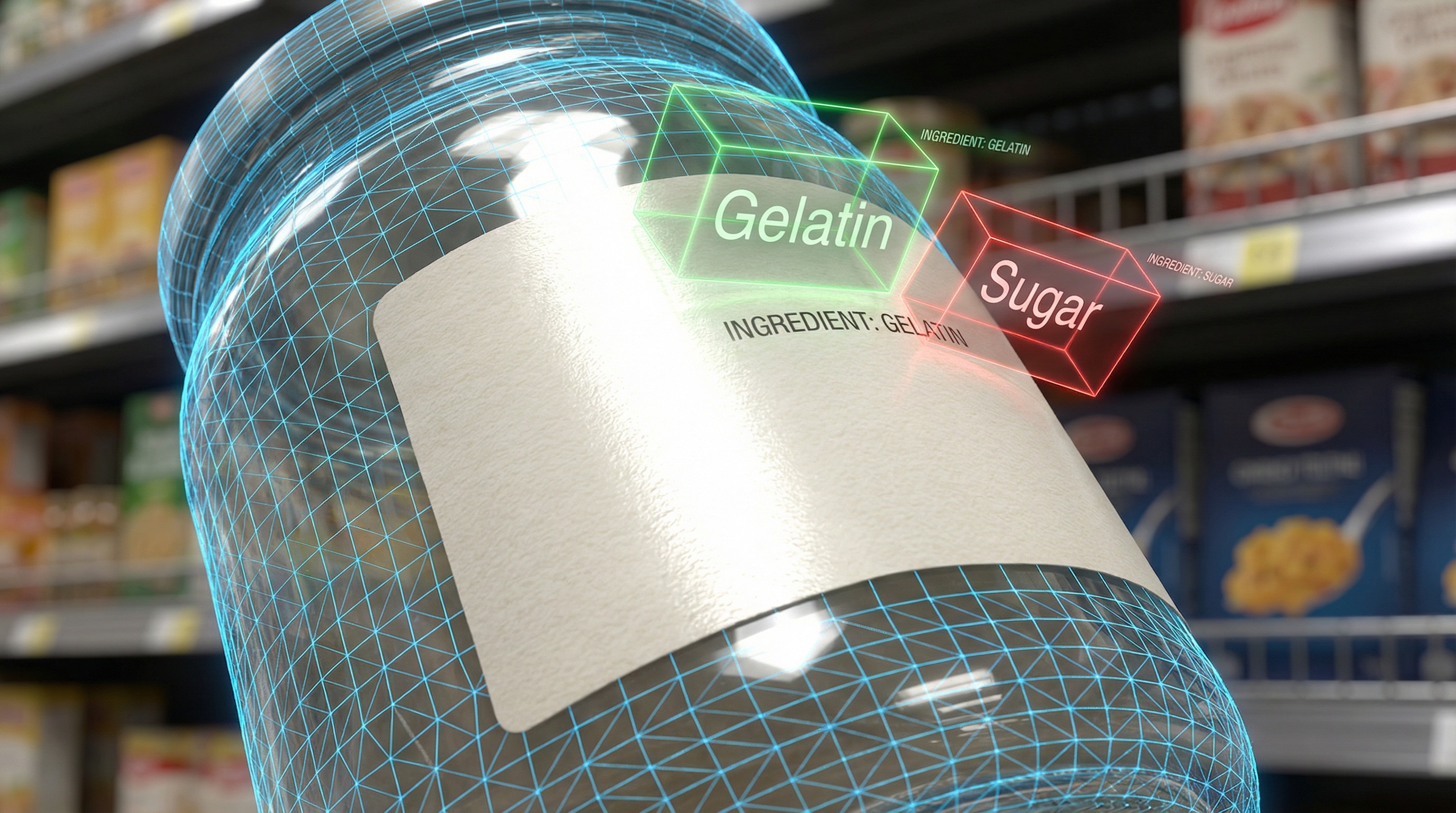
Imagine you are standing in the condiment aisle of a supermarket. You pick up a jar of specialty marinade. The bottle is cylindrical, the label is metallic and reflective, and the font used for the ingredient list is a condensed sans-serif that borders on microscopic. To the human eye, identifying whether this product contains distinct non-kosher derivatives like carmine or gelatin is a trivial, albeit tedious, task. To a standard Optical Character Recognition (OCR) system, this scenario is a nightmare of entropy.
As engineers and physicists, we often view OCR as a solved problem—a commodity API we can call upon to ingest documents. However, the physical reality of product packaging introduces variables that break traditional document-scanning algorithms. The curvature of the bottle introduces geometric distortion; the glossy finish creates specular highlights that obliterate pixel data; and the chaotic styling of modern typography creates false positives. When the stakes are religious compliance—where a single misidentified ingredient renders a product unfit for consumption—95% accuracy is unacceptable. We need an approach that transcends simple pattern matching.
This post explores the physics and engineering behind robust ingredient verification systems. We aren't just reading text; we are reconstructing a 3D surface, correcting for perspective distortion, extracting semantic meaning, and cross-referencing against a highly structured ontology of kosher laws (kashrut). We will move beyond the 'black box' of API calls and dive into the signal processing, affine transformations, and fuzzy logic required to build a computer vision pipeline that sees the world as it actually is.
Theoretical Foundation: From Photons to Semantics
To understand why standard OCR fails on packaging, we must look at the image formation process. A camera sensor captures a 2D projection of a 3D manifold. When identifying text on a curved surface (like a soda can), the distance between the camera center and the text varies across the horizontal axis. This results in non-uniform scaling—letters on the periphery appear compressed compared to letters in the center.
The Geometry of Distortion
To correct this, we utilize Homography, a concept from projective geometry. A homography is an isomorphism of projective spaces, mapping points from one plane to another. In our context, we aim to map the curved surface of the label to a rectified, flat plane (orthorectification).
Mathematically, the relationship between a point in the source image and the destination image is defined by a matrix :
Standard OCR engines (like Tesseract) expect lines of text to be collinear and orthogonal to the pixel grid. By estimating the homography—often by detecting the four corners of the ingredient panel—we can apply an inverse transformation to 'unwrap' the label before pixel analysis begins.
The Stochastic Nature of Recognition
Once the image is rectified, we move from physics to probability. Ingredient recognition is not deterministic; it is stochastic. An OCR engine outputs a probability distribution over the character set for every detected glyph.
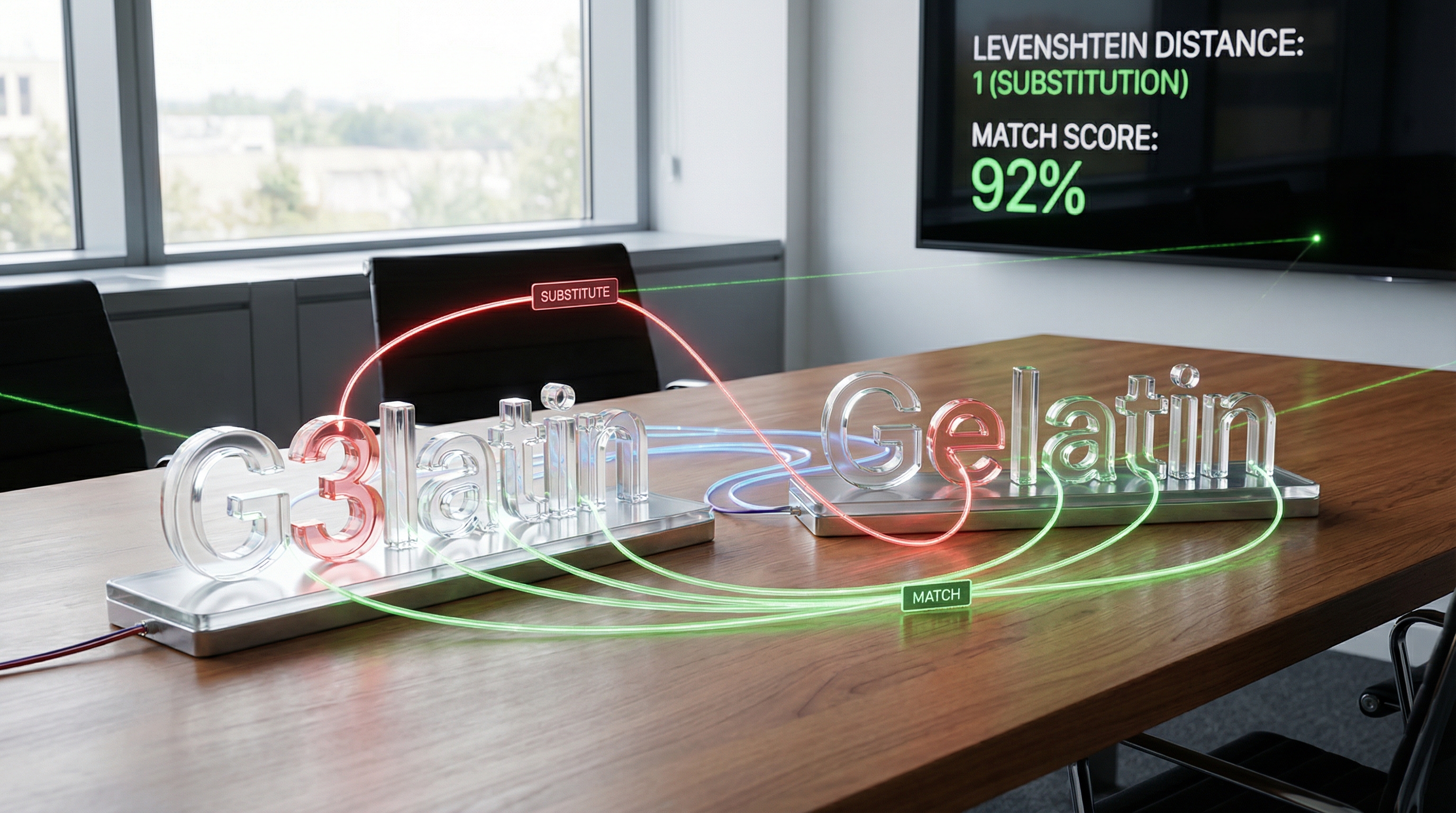
However, in kosher verification, we are looking for specific n-grams (sequences of n items). The word "Gelatin" is an n-gram of high significance. The algorithm doesn't just need to see characters; it needs to calculate the Levenshtein Distance (or edit distance) between the detected string and a database of prohibited ingredients.
The Levenshtein distance between two strings and is the minimum number of single-character edits (insertions, deletions, or substitutions) required to change into . This allows our system to identify "G3latin" or "Gelatine" as a match for the prohibited item "Gelatin," handling the noise inherent in real-world imaging.
Implementation Deep Dive
We will construct a Python pipeline that performs three distinct operations:
- Image Preprocessing: Reducing noise and handling illumination.
- OCR Extraction: Using Tesseract with custom configuration.
- Semantic Verification: Using fuzzy logic to identify kosher status.
Prerequisites
Ensure you have the following libraries installed:
pip install opencv-python pytesseract numpy thefuzz
1. Preprocessing: The Adaptive Threshold
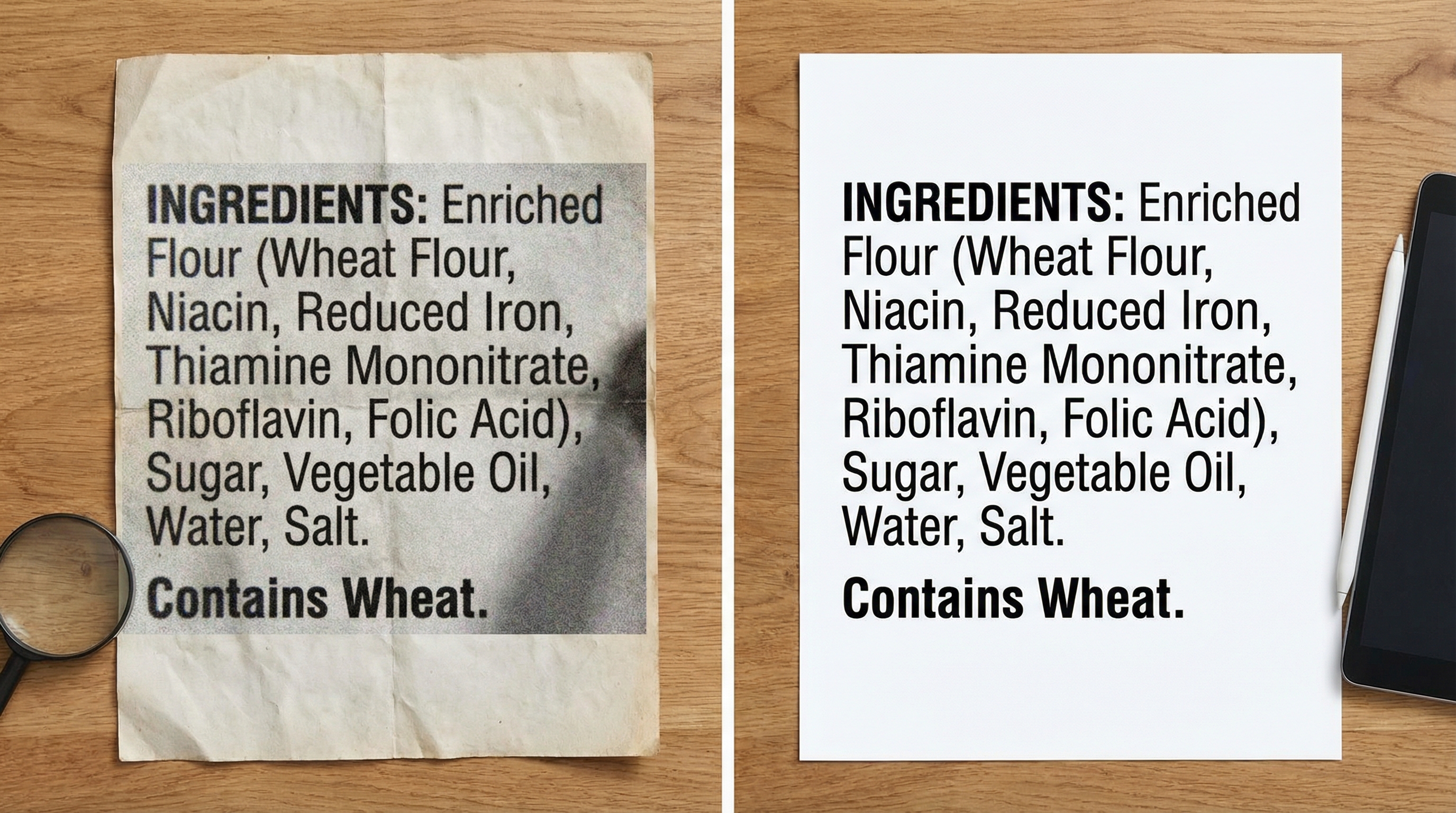
Lighting on product packaging is rarely uniform. A global threshold (converting grayscale to black/white based on a single value) will fail if one side of the jar is in shadow. We use Adaptive Gaussian Thresholding, which calculates the threshold for a pixel based on a weighted sum of its neighbors.
import cv2
import numpy as np
import pytesseract
from thefuzz import fuzz, process

def preprocess_image(image_path):
    """
    Loads an image and applies adaptive thresholding to isolate text
    from complex product backgrounds.

    Args:
        image_path (str): Path to the input image file.

    Returns:
        numpy.ndarray: The preprocessed binary image ready for OCR.
    """
    # 1. Load the image
    image = cv2.imread(image_path)
    if image is None:
        raise FileNotFoundError(f"Could not load image at {image_path}")

    # 2. Convert to Grayscale
    # Color data contributes to noise in text recognition.
    gray = cv2.cvtColor(image, cv2.COLOR_BGR2GRAY)

    # 3. Morphological Operations to remove specular highlights
    # We use a 'Top Hat' transform: difference between input and opening.
    # This highlights bright features (text) on dark backgrounds or vice versa.
    kernel = cv2.getStructuringElement(cv2.MORPH_RECT, (5, 5))
    tophat = cv2.morphologyEx(gray, cv2.MORPH_TOPHAT, kernel)

    # 4. Otsu's Binarization with Gaussian Blur
    # Blur reduces high-frequency noise before thresholding
    blur = cv2.GaussianBlur(tophat, (5, 5), 0)

    # Adaptive thresholding handles varying lighting conditions across the label
    thresh = cv2.adaptiveThreshold(
        blur,
        255,
        cv2.ADAPTIVE_THRESH_GAUSSIAN_C,
        cv2.THRESH_BINARY,
        11,
        2
    )

    return thresh
2. The OCR Engine Configuration
Tesseract is powerful, but out of the box, it is optimized for dense blocks of book text. Product labels are sparse and chaotic. We must tune the Page Segmentation Mode (PSM). For ingredient lists, PSM 6 (Assume a single uniform block of text) or PSM 11 (Sparse text) usually yields better results than the default.
def extract_text_from_label(preprocessed_image):
    """
    Extracts raw text from the binary image using Tesseract OCR.

    Args:
        preprocessed_image (numpy.ndarray): The binary image.

    Returns:
        str: The raw string extracted from the image.
    """
    # Configuration explanation:
    # --oem 3: Default OCR Engine Mode (LSTM neural net)
    # --psm 6: Assume a single uniform block of text.
    #          This works well for ingredient blocks.
    custom_config = r'--oem 3 --psm 6'

    try:
        text = pytesseract.image_to_string(
            preprocessed_image,
            config=custom_config
        )
        return text
    except Exception as e:
        print(f"OCR Engine Error: {e}")
        return ""
3. The Fuzzy Logic Validator
This is the core business logic. We cannot expect a perfect string match. We use the thefuzz library (formerly fuzzywuzzy) which implements Levenshtein distance calculations efficiently. We need a database of 'red flag' ingredients (non-kosher) and 'yellow flag' ingredients (requires certification).
def analyze_ingredients(extracted_text, treif_database, kosher_database):
    """
    Analyzes text against a database of non-kosher (treif) ingredients.

    Args:
        extracted_text (str): The OCR output.
        treif_database (list): List of non-kosher ingredients (e.g., ['pork', 'shellfish', 'carmine'])
        kosher_database (list): List of verified kosher symbols or ingredients.

    Returns:
        dict: A report containing flags and confidence scores.
    """

    # Normalize text: lowercase, remove special chars
    cleaned_text = extracted_text.lower().replace('
', ' ')
    ingredients_found = [x.strip() for x in cleaned_text.split(',')]

    report = {
        'status': 'Unknown',
        'flags': [],
        'confidence_score': 0.0
    }

    # Threshold for fuzzy matching (0-100)
    # 85 is a heuristic balance between false positives and false negatives
    MATCH_THRESHOLD = 85

    for ingredient in ingredients_found:
        # Check against Treif (Non-Kosher) DB
        # process.extractOne finds the best match in the list
        match, score = process.extractOne(ingredient, treif_database)

        if score >= MATCH_THRESHOLD:
            report['flags'].append({
                'detected': ingredient,
                'match': match,
                'score': score,
                'type': 'NON_KOSHER'
            })
            report['status'] = 'NON_KOSHER'

    # Heuristic scoring logic
    if report['status'] == 'NON_KOSHER':
        # High confidence if we found forbidden items
        report['confidence_score'] = max([f['score'] for f in report['flags']]) / 100.0
    else:
        # If nothing found, we are not necessarily safe.
        # Absence of evidence is not evidence of absence in OCR.
        report['status'] = 'POSSIBLY_KOSHER'
        report['confidence_score'] = 0.5  # Neutral confidence

    return report

# --- Execution Example ---
if __name__ == "__main__":
    # Mock Database
    non_kosher_db = ["gelatin", "carmine", "lard", "shellfish", "shrimp", "pork"]

    # Mock Run
    # In a real scenario, 'label_scan.jpg' would be your input
    # Here we simulate the pipeline
    try:
        # processed = preprocess_image('label_scan.jpg')
        # text = extract_text_from_label(processed)

        # Simulating OCR output with typical noise/errors
        simulated_ocr_text = "Ingredients: Sugar, Corn Syrup, G3latin, Red 40, Artificial Flavor"

        analysis = analyze_ingredients(simulated_ocr_text, non_kosher_db, [])

        print(f"Analysis Result: {analysis['status']}")
        print("Flags Detected:")
        for flag in analysis['flags']:
            print(f" - Found '{flag['detected']}' matching '{flag['match']}' (Score: {flag['score']})")

    except Exception as e:
        print(f"Pipeline failed: {e}")
Analysis of the Logic
In the code above, the G3latin typo is the critical edge case. A standard string comparison "gelatin" == "G3latin" returns False. However, the Levenshtein ratio between these two strings is high (likely > 85), triggering the flag. This stochastic approach bridges the gap between the noisy physics of the camera sensor and the rigid binary of dietary laws.
Advanced Techniques & Optimization
While the Tesseract-based pipeline works for general use cases, enterprise-grade ingredient identification requires more sophisticated architecture. The primary bottleneck in the code above is the reliance on simple image binarization, which discards semantic context.
1. Scene Text Detection (EAST/CRAFT)
Before attempting to read the text, we must locate it. Advanced pipelines utilize Deep Learning models like EAST (Efficient and Accurate Scene Text Detector) or CRAFT (Character Region Awareness for Text Detection). These Convolutional Neural Networks (CNNs) output a heat map of text regions, allowing the system to crop specifically to the ingredient list, ignoring marketing fluff like "New Look!" or "Great Taste!".
Implementing EAST allows for rotation invariance. If the user holds the bottle at a 45-degree angle, EAST provides the rotated bounding box, which can be passed to the homography function for realignment.
2. Symbol Recognition with CNNs
Identifying the text is half the battle; identifying the Hechsher (Kosher certification symbol) is the other. Symbols like the OU (Orthodox Union), OK, or Kof-K are graphical logos, not text.
We cannot use OCR for this. Instead, we train a specific object detection model (like YOLOv8 or Faster R-CNN) on a dataset of common kosher logos. This runs in parallel to the OCR pipeline:
- Pipeline A (Text): OCR -> Ingredient Exclusion List.
- Pipeline B (Vision): YOLO -> Certification Inclusion List.
3. Bayesian Inference for Confidence
Instead of a simple threshold for fuzzy matching, a robust system uses Bayesian updating. If the OCR detects "Cream" (Dairy) and "Steak" (Meat) in the same list, the prior probability of the product being Kosher drops to near zero (as mixing meat and milk is forbidden). We can model the relationship between ingredients using a probabilistic graphical model, where the detection of one ingredient influences the probability of correctly decoding its neighbors.
Real-World Applications
The technology described here has applications far extending beyond individual dietary observance.
Automated Supply Chain Auditing: Large food manufacturers must verify that incoming raw materials match their specification sheets. A computer vision system on the conveyor belt can scan drums of additives to ensure no non-compliant substitutions (e.g., a supplier swapping vegetable glycerin for animal glycerin) have entered the facility.
Allergen Safety: The exact same pipeline used for Kosher verification applies to allergen detection. For someone with a severe peanut allergy, misreading "Walnuts" as "Peanuts" (or vice versa) is a life-or-death scenario. The fuzzy logic thresholds can be tuned to be more aggressive for allergens, prioritizing recall over precision to ensure safety.
Retail Inventory Management: Smart shelf-labeling systems use similar CV techniques to verify that products placed on shelves match the price tags below them, alerting staff to misplaced stock.
External Reference & Video Content
In the video "Advanced Computer Vision," the lecturers typically discuss the evolution from hand-crafted features (like HAAR cascades) to deep learning representations. For our purpose, the segment on Attention Mechanisms in Transformers is most relevant.
Modern OCR is moving away from LSTM-based approaches (like Tesseract 4.0) toward Vision Transformers (ViT) and multimodal models (like CLIP). The video explains how attention mechanisms allow the model to focus on specific parts of an image while processing the sequence. In ingredient reading, this means the model can learn to pay attention to the word "Contains:" and weigh the subsequent text more heavily than the nutritional facts panel. Understanding these attention maps is crucial for debugging why a model might miss a specific ingredient—often, it's because the model's "attention" was drawn to a high-contrast logo rather than the low-contrast text.
Conclusion & Next Steps
Identifying kosher ingredients via computer vision is a perfect example of a "full-stack" engineering problem. It requires a mastery of optics to capture the image, linear algebra to unwrap the geometry, deep learning to extract the features, and fuzzy logic to interpret the semantics. We have moved beyond simple OCR into the realm of Scene Understanding.
To advance this project, I recommend the following steps:
- Build a Dataset: Collect 500 images of curved product labels with ground-truth text.
- Train a YOLO Model: specifically for locating the "Ingredients" block on a package.
- Integrate an API: Use the Open Food Facts database to cross-reference OCR results with known product data.
The future of food safety and compliance isn't in better reading; it's in better understanding. By combining physics-based preprocessing with probabilistic logic, we can build systems that see the truth behind the label.
Computer Vision for Food Recognition - Deep Learning Tutorial
Learn how to build computer vision systems for food recognition and ingredient identification using deep learning, including OCR and image classification techniques.