Understanding Grid Trading: Mathematical Analysis of Volatility Strategies

Financial Disclaimer - Educational Content Only
This content is for educational and academic purposes only. It presents theoretical and mathematical concepts for understanding financial market mechanics. This is NOT financial, investment, or trading advice. The code examples, formulas, and strategies discussed are presented for educational understanding only and should NOT be used for actual trading or investment purposes. Trading cryptocurrencies and other financial instruments involves substantial risk of loss, including the possibility of losing your entire investment. Past performance is not indicative of future results. The mathematical models and algorithms discussed are theoretical and may not perform as described in real market conditions. Always conduct your own research and consult with a qualified financial advisor before making any investment decisions. The author and D613 Labs are not responsible for any financial losses incurred from following, implementing, or attempting to use any information, code, or strategies discussed in this content.
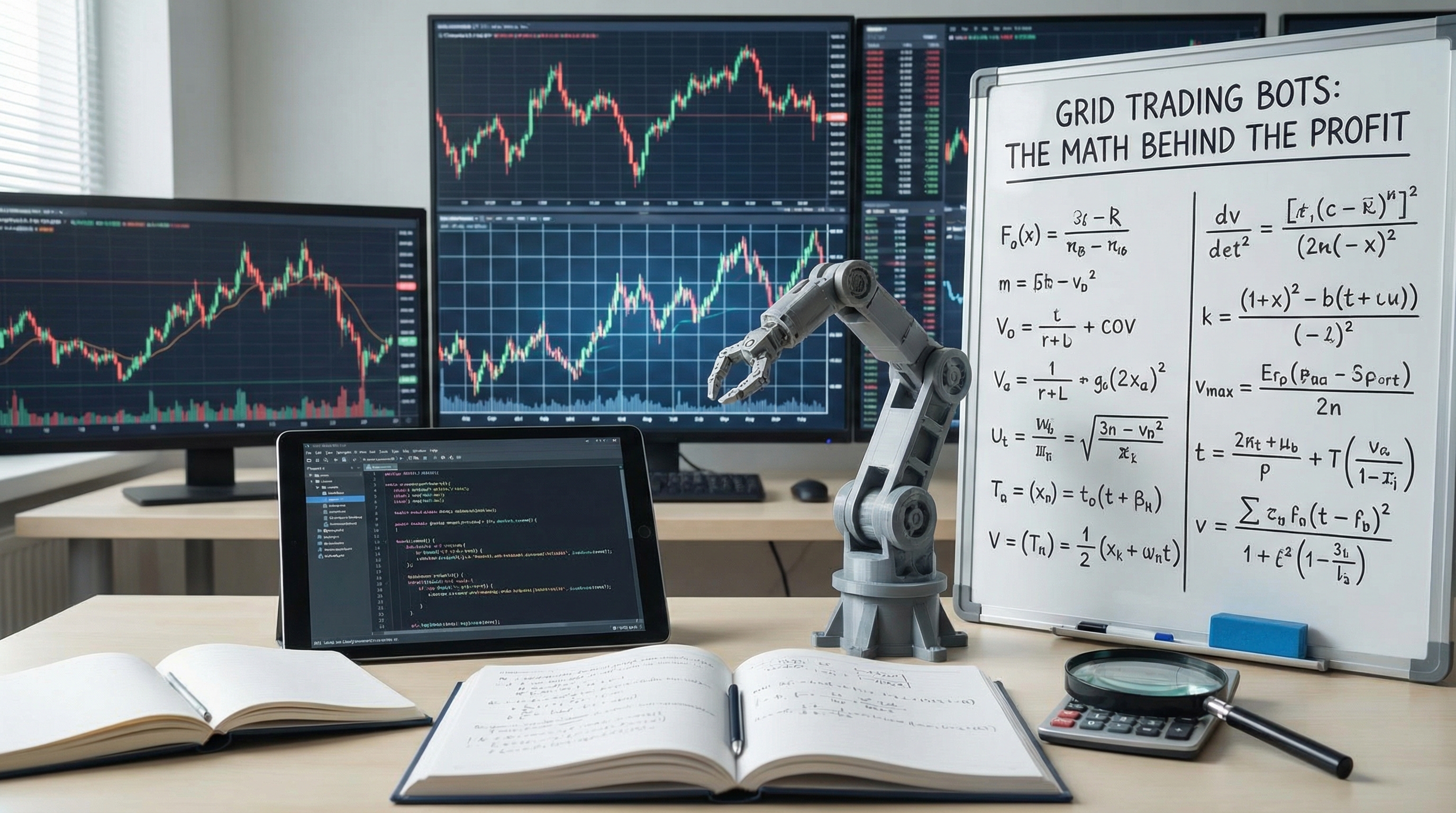
Building Grid Trading Bots: The Math Behind the Profit
1. Introduction: Ordering the Chaos of Market Entropy
In the realm of Applied Physics, we often deal with systems defined by high entropy—thermodynamic systems where individual particle trajectories are stochastic, yet the aggregate behavior follows predictable laws. Financial markets are strikingly similar. The novice trader looks at a price chart and attempts to predict the specific vector of a price asset—essentially trying to calculate the deterministic path of a specific gas molecule in a heated chamber. This is a exercise in futility, bounded by Heisenberg-like uncertainty principles of information asymmetry.
As engineers and physicists, we don't bet on the particle; we build engines that harvest energy from the thermal agitation itself. This is the essence of Grid Trading.
Imagine an ocean surface. A directional trader tries to predict if the tide is coming in or going out. A grid trader, however, builds a hydroelectric dam that generates power regardless of the tide's direction, provided there is wave motion (volatility). If the water moves up, we sell potential energy; if it moves down, we store it.
The engineering problem we face is this: How do we construct a lattice of limit orders that maximizes the extraction of profit from market noise (volatility) while minimizing the risk of ruin (impermanent loss)?
Most commercial trading bots are black boxes with simplified logic. In this educational analysis, we will examine the mathematical foundations and stochastic calculus underlying grid trading strategies. We will treat the market as an Ornstein-Uhlenbeck process (mean-reverting) and analyze the theoretical optimization of grid spacing and capital allocation from a mathematical perspective. This article presents these concepts for academic understanding and educational purposes only.
2. Theoretical Foundation: The Physics of the Grid
To understand grid trading, we must first abstract price movement. We are not interested in fundamental valuation here; we are interested in the amplitude and frequency of price oscillation.
The Mathematical Lattice
A grid strategy creates a zone of liquidity. We define a lower bound () and an upper bound (). Within this range, we distribute orders.
There are two primary mathematical approaches to spacing these orders, analogous to linear vs. logarithmic scales in signal processing:
1. Arithmetic Progression (Linear Grid)
Used best when the price range is relatively narrow. The difference between price levels is a constant .
Where:
In this model, the profit per grid execution is not constant in percentage terms, but constant in absolute quote currency terms.
2. Geometric Progression (Logarithmic Grid)
Used for wide ranges or hyper-volatile assets (like crypto). The ratio between price levels is a constant . This ensures that every trade yields the exact same percentage profit, maintaining the geometric consistency of the portfolio.
Where:
The Profit Equation and Impermanent Loss
The theoretical profit of a grid bot is a function of volatility. If we assume the price follows a random walk within our bounds, the total realized profit () is the summation of grid crossings.
However, we must account for Impermanent Loss (IL). As the price drops, the bot buys more asset. If the price leaves the bottom of the grid, you are left holding a "bag" of depreciating assets. Conversely, if the price shoots above the grid, you have sold all your assets early and miss the upside.
Therefore, the grid trading strategy is essentially a short volatility put spread combined with a short volatility call spread. We are shorting volatility at the edges and longing volatility in the center.

The optimization problem is finding the "Sweet Spot" for (grid count).
- Too few grids: You miss micro-fluctuations (low sampling rate).
- Too many grids: Transaction fees eat the profit margin (signal-to-noise ratio degrades).
If is the transaction fee percentage, the minimum grid spacing must satisfy:
Where is the average price level. This ensures that the profit from each grid execution exceeds the round-trip transaction costs.
3. Mathematical Optimization Theory
From a theoretical perspective, grid trading optimization involves:
- Grid Count Optimization: Finding the optimal that balances profit capture with transaction costs
- Price Range Selection: Determining and based on historical volatility
- Capital Allocation: Distributing funds across grid levels to maximize risk-adjusted returns
3.1 Volatility-Based Grid Spacing
The optimal grid spacing can be derived from historical volatility (). For a mean-reverting process, the grid spacing should be proportional to the standard deviation:
Where is the time horizon and is the volatility parameter.
3.2 Impermanent Loss Analysis
Impermanent loss occurs when the price moves outside the grid bounds. Mathematically, if the price moves from to where or , the strategy experiences:
Where and represent the quantities held or sold at the grid boundaries.
4. Academic Research & Market Microstructure
Grid trading strategies are related to market making in traditional finance. Academic research on market microstructure provides theoretical foundations for understanding these mechanisms:
- Order Book Dynamics: How limit orders interact with market orders
- Volatility Clustering: The tendency of volatility to cluster in time
- Mean Reversion: Statistical properties of price returns
5. Conclusion: Understanding Volatility Strategies
Grid trading represents a theoretical approach to harvesting volatility in mean-reverting markets. The mathematical models we've discussed—stochastic processes, grid spacing optimization, and impermanent loss analysis—provide a framework for understanding these strategies from an academic perspective.
Further Reading & Academic References
Textbooks:
- Market Microstructure Theory by Maureen O'Hara - Order book dynamics
- Stochastic Calculus by Steven Shreve - Mathematical foundations
- Academic research on volatility strategies and market making
Research Papers:
- Studies on mean reversion in financial markets
- Research on optimal market making strategies
- Papers on volatility harvesting techniques
This article has presented these concepts for educational and academic understanding only. The mathematical models and strategies discussed are theoretical and should not be used for actual trading or investment purposes.
Grid Trading Strategy Explained - Algorithmic Trading
An in-depth explanation of grid trading strategies, including the mathematical principles behind automated trading bots that profit from market volatility.