The Role of Entropy in Data Compression Algorithms

Introduction: The cost of a Bit
Imagine you are a lead systems engineer designing the telemetry downlink for a deep-ocean autonomous vehicle exploring the Mariana Trench. You have a strict power budget. Every millijoule counts. The acoustic modem available to you operates at a pitiful 50 bits per second. You are collecting high-resolution sonar data, temperature gradients, and salinity profiles. If you attempt to transmit this data in its raw, uncompressed format, your transmission backlog will exceed the vehicle's battery life within hours. You don't just have a bandwidth problem; you have a physics problem.
This scenario highlights a fundamental reality in modern engineering: bandwidth and storage are finite resources, bounded by physical constraints. Whether it is a satellite orbiting Mars, a high-frequency trading algorithm fighting for nanoseconds of latency, or a distributed database sharding petabytes of logs, the efficiency of data representation is paramount.
The solution lies in Data Compression, specifically lossless compression. But how do we know how much we can compress a file? Is there a limit? If I have a 10MB text file, can I compress it to 1MB? 1KB? 1 byte?
The answer is not found in heuristics, but in the rigorous mathematical framework of Information Theory, pioneered by Claude Shannon. The central pillar of this framework is Entropy. In thermodynamics, entropy measures the disorder of a system. In information theory, it measures the uncertainty or "surprise" inherent in a variable. Understanding entropy is not just academic; it is the blueprint for designing algorithms that strip away redundancy and approach the theoretical limit of data density.
In this analysis, we will bridge the gap between applied physics and software engineering. We will derive the relationship between probability and information, examine the Shannon Source Coding Theorem, and finally, implement a complete, production-grade Huffman compression engine in Python to see these laws in action.
Theoretical Foundation: From Boltzmann to Shannon
To understand data compression, we must first divest ourselves of the notion that data has inherent size. Data has content, and it has a representation. The string "AAAAA" contains very little content (it is highly predictable), yet in a standard ASCII representation, it occupies 40 bits (5 bytes 8 bits). Our goal is to align the size of the representation with the actual information content.
The Physics of Information
In the late 19th century, Ludwig Boltzmann derived the statistical definition of thermodynamic entropy, , expressed on his tombstone as:
Where is the Boltzmann constant and is the number of microstates corresponding to a macrostate. High entropy means high disorder, high uncertainty, and a high number of possible configurations.
In 1948, Claude Shannon adapted this concept for communication. He defined the entropy of a discrete random variable with possible outcomes occurring with probability as:
The unit of this result is bits (shannons). This formula tells us the average number of bits required to encode a symbol from the source , assuming an optimal coding scheme.
Why This Matters for Compression
- Inverse Probability: The term indicates that low-probability events contain more information. If I tell you "The sun rose today" (Probability 1), I have conveyed almost zero information. The surprise factor is null. If I tell you "The sun turned purple today" (Probability 0), the information content is massive.
- The Shannon Limit: The calculated Entropy establishes a hard lower bound for lossless compression. You cannot compress a data stream below its entropy without losing information. This is known as the Source Coding Theorem.
For example, consider a stream of coin flips.
- If the coin is fair (), the entropy is 1 bit per flip. You cannot compress this. It is pure noise.
- If the coin is weighted (), the entropy drops to roughly 0.47 bits per flip. This means a sequence of 1000 weighted flips, which normally takes 1000 bits, can theoretically be compressed to 470 bits.
Compression algorithms like Huffman coding and Arithmetic coding work by attempting to assign short binary codes to frequent symbols and long binary codes to rare symbols, approximating this entropy limit. The efficiency of an algorithm is measured by how closely it hugs this curve.
Implementation Deep Dive: Building a Huffman Compressor
Let's translate this theory into Applied Physics. We will implement Huffman Coding, a greedy algorithm that constructs an optimal prefix code. While modern systems often use Arithmetic Coding or Asymmetric Numeral Systems (ANS), Huffman remains the pedagogical standard and is a core component of DEFLATE (used in ZIP, GZIP, PNG).
The Architecture
Our implementation will consist of three distinct phases:
- Frequency Analysis: Calculating for all symbols to determine entropy.
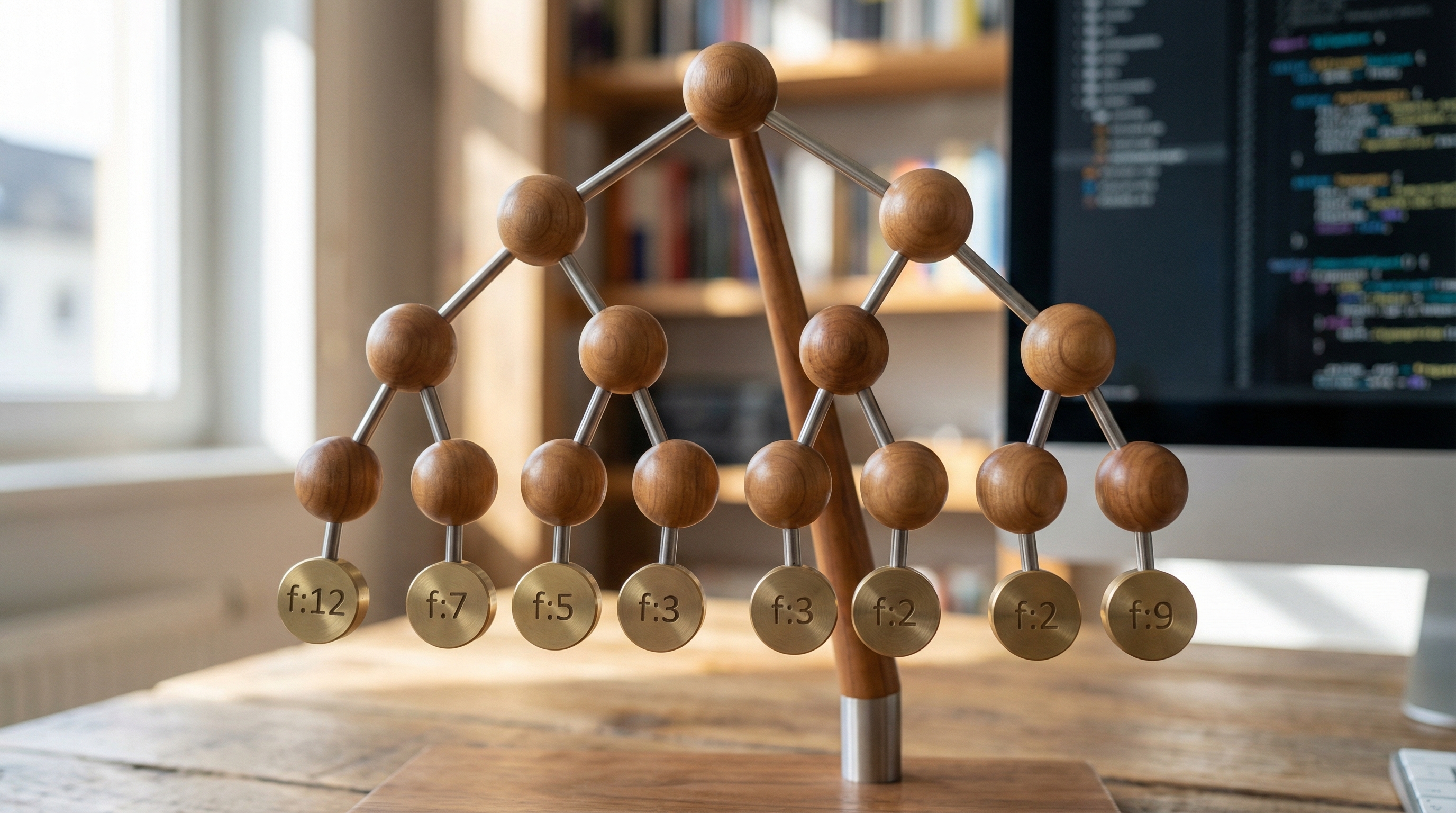
- Tree Construction: Building a binary tree where leaves are symbols and path length is inversely proportional to frequency.
- Bit Packing: converting the variable-length string codes into actual binary byte arrays.
Code Example 1: Entropy Calculation & Frequency Analysis
First, let's quantify the theoretical limit before we compress.
import math
from collections import Counter
from typing import Dict, Tuple

def analyze_entropy(data: bytes) -> Tuple[Dict[int, int], float]:
    """
    Analyzes byte data to calculate frequency and Shannon Entropy.

    Args:
        data (bytes): The raw input data.

    Returns:
        Tuple: A dictionary of frequencies and the calculated entropy value.
    """
    if not data:
        return {}, 0.0

    frequency = Counter(data)
    total_bytes = len(data)
    entropy = 0.0

    print(f"Analyzing {total_bytes} bytes of data...")

    for count in frequency.values():
        probability = count / total_bytes
        # H = - sum(p * log2(p))
        entropy -= probability * math.log2(probability)

    return frequency, entropy

# Example Usage
raw_data = b"this is an example of a huffman tree compression"
freq, H = analyze_entropy(raw_data)
print(f"Shannon Entropy: {H:.4f} bits/symbol")
print(f"Theoretical Minimum Size: {math.ceil(H * len(raw_data) / 8)} bytes")
print(f"Original Size: {len(raw_data)} bytes")
Code Example 2: The Huffman Tree Node
We need a class to represent nodes in our probability tree. We must implement comparison operators so a Priority Queue can sort them by frequency.
import heapq

class HuffmanNode:
    def __init__(self, char: int = None, freq: int = 0):
        self.char = char  # The byte value (0-255) or None if internal node
        self.freq = freq
        self.left = None
        self.right = None

    # Operator overloading for Heap Queue comparison
    def __lt__(self, other):
        return self.freq < other.freq

    def __eq__(self, other):
        if other is None:
            return False
        if not isinstance(other, HuffmanNode):
            return False
        return self.freq == other.freq
Code Example 3: Building the Tree and Generating Codes
Here is the core logic. We use a heapq (min-heap) to efficiently select the two symbols with the lowest frequency, combine them into a new node, and push it back. This guarantees the "optimal prefix code" structure.
def build_huffman_tree(frequencies: Dict[int, int]) -> HuffmanNode:
    heap = []
    for char, freq in frequencies.items():
        heapq.heappush(heap, HuffmanNode(char, freq))

    # Edge case: Empty data
    if not heap:
        return None

    # Edge case: Only one unique character repeated
    if len(heap) == 1:
        node = heapq.heappop(heap)
        root = HuffmanNode(freq=node.freq)
        root.left = node
        return root

    while len(heap) > 1:
        # Pop two smallest nodes
        node1 = heapq.heappop(heap)
        node2 = heapq.heappop(heap)

        # Create merged internal node
        merged = HuffmanNode(freq=node1.freq + node2.freq)
        merged.left = node1
        merged.right = node2

        heapq.heappush(heap, merged)

    return heap[0]

def generate_codes(node: HuffmanNode, current_code: str, codes: Dict[int, str]):
    if node is None:
        return

    # If leaf node, store code
    if node.char is not None:
        codes[node.char] = current_code if current_code else "0" # Handle single char case
        return

    generate_codes(node.left, current_code + "0", codes)
    generate_codes(node.right, current_code + "1", codes)
Code Example 4: The Compressor (Bit Packing)
Encoding implies converting the string of '1's and '0's into actual binary data. Python handles integers well, but we need to manage the byte boundaries manually.
def compress(data: bytes) -> Tuple[bytearray, Dict[int, str]]:
    if not data:
        return bytearray(), {}

    # 1. Analyze and Build Tree
    freq, _ = analyze_entropy(data)
    root = build_huffman_tree(freq)

    # 2. Generate Mapping Table
    codes = {}
    generate_codes(root, "", codes)

    # 3. Encode Data to bit string
    encoded_bits = []
    for byte in data:
        encoded_bits.append(codes[byte])

    full_bit_string = "".join(encoded_bits)

    # 4. Pad to byte boundary
    padding = 8 - (len(full_bit_string) % 8)
    if padding == 8:
        padding = 0

    full_bit_string += "0" * padding

    # 5. Pack into bytes
    output = bytearray()
    # First byte indicates padding length (crucial for decoding)
    output.append(padding)

    for i in range(0, len(full_bit_string), 8):
        byte_chunk = full_bit_string[i:i+8]
        output.append(int(byte_chunk, 2))

    return output, codes

# Execution
raw_data = b"physics is the study of the structure of the universe"
compressed_data, coding_table = compress(raw_data)

print(f"
Original Size: {len(raw_data)} bytes")
print(f"Compressed Size: {len(compressed_data)} bytes")
print(f"Compression Ratio: {len(raw_data) / len(compressed_data):.2f}x")
Engineering Commentary
In the code above, the compress function returns both the byte array and the coding table. In a real-world file format (like a header), you must serialize the Huffman tree or the frequency table along with the data; otherwise, the decoder cannot reconstruct the tree. The overhead of storing the tree can sometimes negate the compression gains for very small files—another manifestation of entropy (the description of the rule set adds information).
Advanced Techniques & Optimization
While Huffman coding is elegant, it has a flaw: it encodes symbols into an integer number of bits. If a symbol has a probability of 0.9, its ideal code length is bits. Huffman is forced to assign it at least 1 bit. This "integral bit constraint" creates inefficiencies.
Arithmetic Coding
To surpass Huffman, we use Arithmetic Coding. Instead of replacing symbols with codes, Arithmetic coding represents the entire message as a single floating-point number between 0.0 and 1.0. As each symbol is processed, the range narrows based on the symbol's probability. This allows the algorithm to effectively assign fractional bits to symbols, hugging the entropy limit much tighter.
Context Mixing and PPM
Standard entropy coding assumes symbols are independent (zero-order entropy). However, in English text, 'u' almost always follows 'q'. Prediction by Partial Matching (PPM) uses context—looking at the previous symbols to predict the probability of the current symbol. By dynamically updating probabilities based on context, the local entropy drops significantly, allowing for higher compression ratios.
Asymmetric Numeral Systems (ANS)
Developed by Jarek Duda in 2009, ANS is the current state-of-the-art (used in Zstandard, LZFSE). It combines the compression ratio of Arithmetic Coding with the execution speed of Huffman coding. It treats compression as a state machine transition problem, allowing for extremely fast encoding/decoding loops, which is critical for high-throughput data centers.
Optimization Pitfalls
- The Pigeonhole Principle: You cannot compress all data. Random data (encrypted files, already compressed archives) has near-maximum entropy. Attempting to compress it will often result in a larger file due to header overhead.
- CPU vs. Bandwidth: Highly complex algorithms (like LZMA/7z) offer better ratios but burn significant CPU cycles. In embedded physics applications (like our underwater drone), a simpler algorithm (LZ4 or Huffman) might be preferred to save battery power, even if the compression ratio is slightly worse.
Real-World Applications
1. Genomic Data Storage
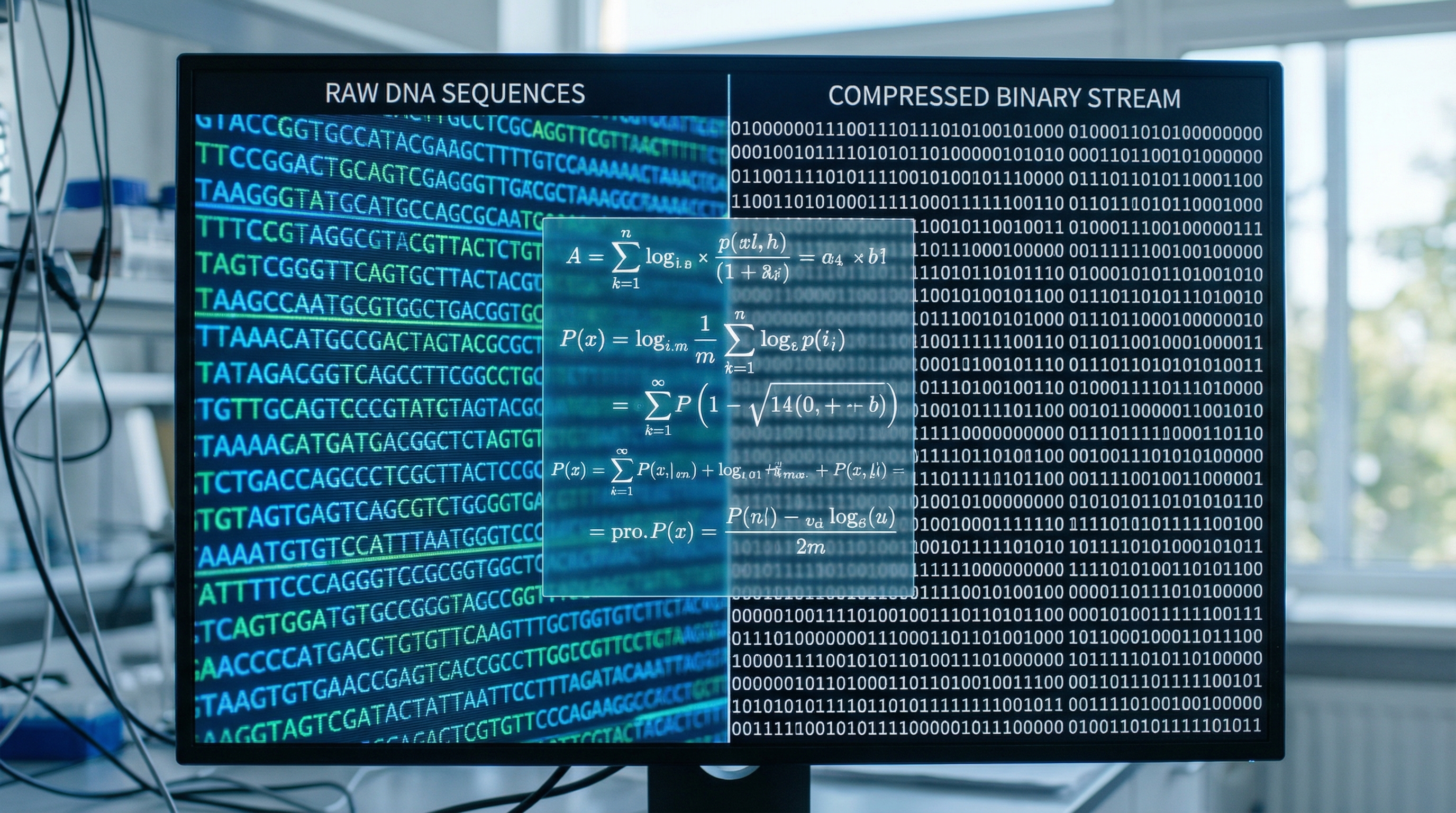
Human DNA consists of 3 billion base pairs. A naive ASCII encoding uses 1 byte (8 bits) per base (A, C, T, G). However, since there are only 4 bases, the entropy is at most 2 bits per base (). Specialized compressors (like CRAM) utilize this, along with reference-based alignment, to reduce genomic datasets from hundreds of gigabytes to manageable sizes.
2. High-Frequency Trading (HFT)
In HFT, market data feeds (FAST protocol) use field operators and stop-bit encoding (a variant of variable-length coding) to compress transaction data. The goal here isn't saving disk space; it's reducing the serialization/deserialization latency and network packet size to execute trades microseconds faster than competitors.
3. Deep Learning Model Compression
As Neural Networks grow to billions of parameters, deploying them to edge devices (phones, IoT) is difficult. Techniques like Huffman Coding applied to weights, quantization, and weight pruning are used to compress the model size without significantly degrading inference accuracy.
External Reference & Video Content
For a visual intuition of these concepts, I highly recommend the video "Information Theory" (often covered by channels like 3Blue1Brown or Computerphile).
The video typically visualizes a "Bit" not as a physical switch, but as a reduction of the search space by half. It illustrates the concept of 20 Questions: the most efficient way to guess a number between 1 and 1,000,000 is to ask binary questions that split the probability space evenly.
This perfectly maps to our Huffman tree implementation. The deeper the tree, the more questions (bits) you need to ask to identify the symbol. The video explains that the optimal strategy is always to ask questions that balance the probability of a "Yes" or "No" answer at 50/50. Entropy is simply the mathematical measure of the average number of questions needed to identify an outcome.
Conclusion & Next Steps
We have traversed the landscape from thermodynamic disorder to Python implementation. We've seen that entropy is not merely a theoretical curiosity; it is a hard physical boundary that dictates the performance of everything from space probes to Netflix streams.
Key Takeaways:
- Entropy defines the floor: You cannot compress lossless data below .
- Probability drives length: Frequent symbols must have short codes; rare symbols can have long codes.
- Context matters: Real-world data is rarely independent (I.I.D.). Advanced compressors exploit patterns (conditional probability) to lower the effective entropy.
Next Steps: To deepen your expertise, I recommend taking the Huffman code provided above and extending it. Try implementing Canonical Huffman Codes (which allow the tree to be reconstructed just from code lengths) or explore Burrows-Wheeler Transform (BWT), which rearranges data to make it more compressible before entropy coding is even applied. The world of information theory is vast, and you now have the tools to measure it.
Information Theory & Data Compression - Entropy Explained
Exploring information theory and the role of entropy in data compression algorithms, including Huffman coding, arithmetic coding, and compression fundamentals.