Tokenomics 101: Designing a Sustainable Web3 Economy

Financial Disclaimer - Educational Content Only
This content is for educational and academic purposes only. It presents theoretical and mathematical concepts for understanding financial market mechanics. This is NOT financial, investment, or trading advice. The code examples, formulas, and strategies discussed are presented for educational understanding only and should NOT be used for actual trading or investment purposes. Trading cryptocurrencies and other financial instruments involves substantial risk of loss, including the possibility of losing your entire investment. Past performance is not indicative of future results. The mathematical models and algorithms discussed are theoretical and may not perform as described in real market conditions. Always conduct your own research and consult with a qualified financial advisor before making any investment decisions. The author and D613 Labs are not responsible for any financial losses incurred from following, implementing, or attempting to use any information, code, or strategies discussed in this content.
1. Introduction: The Entropy of Poor Design
In November 1940, the Tacoma Narrows Bridge collapsed into the Puget Sound. It didn't fall because the steel was weak or the concrete was flawed; it fell because of aeroelastic flutter—a self-exciting vibration where the bridge's natural frequency matched the aerodynamic forces of the wind. The structure lacked the damping mechanisms necessary to dissipate energy, leading to a catastrophic system failure.
In the Web3 ecosystem, we witness the equivalent of the Tacoma Narrows collapse on a weekly basis. We call them "rug pulls," "death spirals," or "hyperinflationary crashes," but to an applied physicist, these are predictable outcomes of poorly damped systems. When a token economy is designed without rigorous attention to conservation laws and feedback loops, it succumbs to the entropy of the market. The moment speculative inflows (energy) cease to match the inflationary pressure (mass), the system enters a resonant frequency of selling that tears the economy apart.
Designing a sustainable token economy—or "Tokenomics"—is not a marketing exercise; it is a discipline of mechanism design and control theory. It requires the same rigor as designing a thermodynamic system. You are engineering a closed-loop economy where incentives act as forces, tokens act as mass, and liquidity acts as energy.
In this educational guide, we will move beyond the superficial "supply and demand" charts. We will explore the physics of value flow, the calculus of bonding curves, and the game-theoretic equilibria required to sustain a protocol long-term. We will examine the theoretical foundations of token economic mechanisms and analyze existing protocol designs from an academic perspective. This content is for educational and academic purposes only.
2. Theoretical Foundation: The Physics of Value
To build a sustainable system, we must first define the governing equations. In classical mechanics, we rely on Newton's laws. In tokenomics, we rely on the Equation of Exchange and Control Theory.
The Equation of Exchange
Derived from monetary economics, this equation is the fundamental constraint of any currency system:
Where:
- M (Money Supply): The total amount of tokens in circulation.
- V (Velocity): The frequency at which one unit of currency is used to purchase domestically-produced goods and services within a given time period.
- P (Price Level): The average price of goods/services in the ecosystem.
- Q (Real Value/GDP): The index of the real value of expenditures (network utility).
For a token price () to increase without rampant inflation of the supply (), the network utility () must rise, or the velocity () must decrease (via staking or locking mechanisms). A naive tokenomics model often increases (inflationary rewards) hoping to bootstrap , but without a sink to reduce , the result is a collapse in . This is the mathematical definition of a death spiral.
Control Theory and PID Loops
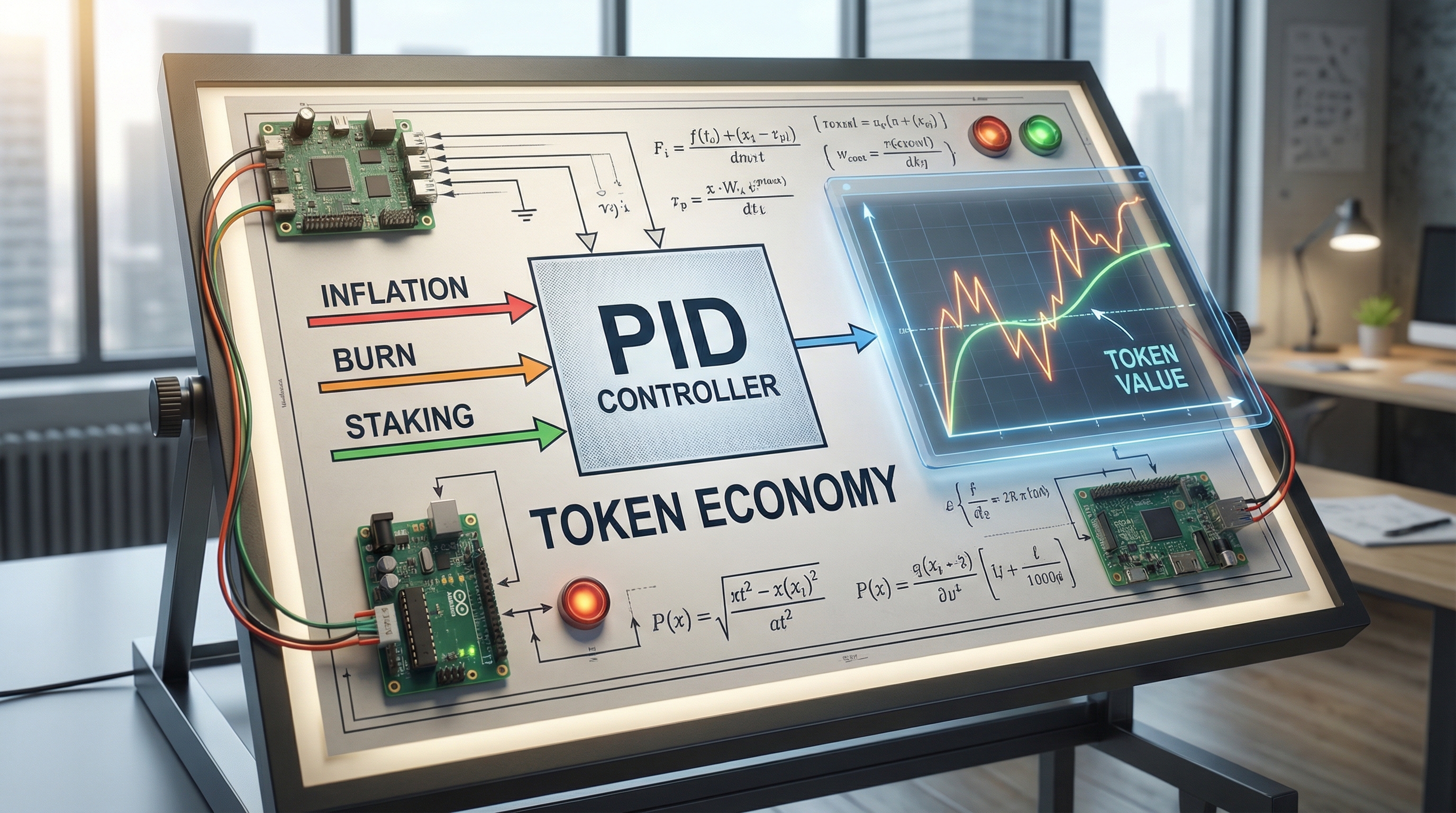
An effective token economy functions like a PID (Proportional-Integral-Derivative) controller. The protocol must adjust parameters dynamically to maintain equilibrium.
- Proportional (P): Immediate response to price deviation (e.g., arbitrage).
- Integral (I): Accumulation of past errors (e.g., treasury accumulation over time).
- Derivative (D): Prediction of future errors (e.g., adjusting bonding curve slope based on volatility).
Bonding Curves: The Calculus of Liquidity
A bonding curve is a smart contract that acts as a market maker, managing the relationship between token supply and price. It is defined by a mathematical function , where is price and is supply.
The reserve collateral () required to back a supply () is the integral of the price curve:
If we use a power function , the reserve required is:
Understanding this calculus is crucial. A steep curve () rewards early adopters disproportionately but creates high volatility (high energy state). A flat curve () provides stability but low speculative incentive. The "Applied Physics" of tokenomics is selecting the correct exponent () to match the expected growth phase of the network.
3. Economic Mechanisms: Theoretical Analysis
From a theoretical perspective, sustainable token economies employ several key mechanisms that can be analyzed mathematically. Understanding these concepts provides insight into how existing protocols operate.
3.1 Deflationary Mechanisms: Velocity Control

A deflationary token mechanism introduces friction to the velocity of money by burning a portion of every transfer. Mathematically, this can be expressed as:
Where is the burn rate (typically 1-5% of the transfer amount).
This mechanism creates a "sink" in the thermodynamic model, reducing the circulating supply over time. The mathematical relationship between burn rate and supply reduction is:
Where is the supply at time and is the initial supply.
This is analogous to friction in physical systems, where energy is dissipated as heat. In token economics, the "burned" tokens represent removed supply, creating upward pressure on the remaining tokens' value.
3.2 Vesting Mechanisms: Supply Curve Flattening
To prevent supply shocks (impulse functions in control theory), tokens allocated to team members or early investors are released gradually. Linear vesting follows the mathematical model:
This flattens the supply curve, preventing sudden increases in circulating supply that could destabilize price.
3.3 Bonding Curves: Price-Supply Relationships
Bonding curves define the mathematical relationship between token supply and price. For a power function , the reserve required to back a supply is:
In practice, protocols like Bancor use a continuous token model where:
This creates a dynamic pricing mechanism where price increases as supply increases, but at a rate controlled by the reserve ratio.
3.4 Implementation Considerations
From a computer science perspective, implementing these mechanisms in smart contracts requires:
- Fixed-point arithmetic: Handling fractional calculations without precision loss
- Gas optimization: Minimizing computational cost of mathematical operations
- Security: Preventing reentrancy attacks and overflow vulnerabilities
- Oracle integration: Reliable price feeds for mechanisms that depend on external data
These are standard considerations in smart contract development, but the mathematical foundations are more important than any specific implementation.
4. Advanced Techniques & Optimization
Once the foundational mechanics are in place, we must optimize the system for longevity and attack resistance. This is akin to aerodynamic streamlining.
Vote-Escrowed (ve) Tokenomics
Popularized by Curve Finance, the "ve" model addresses the velocity problem by enforcing long-term alignment. Users lock tokens for a period (e.g., 1 to 4 years) to receive governance power and boosted rewards. The voting power decays linearly over time.
- Mathematical impact: This creates a sink for (velocity). Even if (supply) increases, the circulating decreases or stabilizes, supporting (price).
- Mathematical Model: The voting power decays linearly:
(3,3) Game Theory & Nash Equilibrium
Derived from the Prisoner’s Dilemma, this model posits that if all participants stake (3,3), everyone wins via protocol growth. If one sells (-1, 1), they gain at others' expense. If everyone sells (-3, -3), the system collapses.
- Pitfall: This relies heavily on psychological momentum. Without external utility (revenue from products), (3,3) is simply a redistribution of wealth, not a creation of it. Purely inflationary staking yields eventually succumb to gravity.
Dynamic Fees & Algorithmic Stabilization
Advanced protocols do not use static fees. They use PID controllers to adjust fees based on network usage.
- Theoretical Model: When network utilization exceeds a threshold (e.g., 80%), the protocol can dynamically increase the burn rate. This creates a negative feedback loop: High usage → Higher burn → Reduced supply → Price support.
Common Pitfall: The Oracle Problem. If your bonding curve or reward mechanism relies on an external price feed (e.g., Chainlink), you introduce latency and manipulation risks. Spot Price derived from an Automated Market Maker (AMM) is instantaneous but susceptible to Flash Loan attacks. Always use Time-Weighted Average Price (TWAP) or decentralized oracles with staleness checks to prevent economic exploits.
5. Real-World Applications
Case Study 1: Ethereum (EIP-1559)
Ethereum transitioned from a pure auction mechanism to a base fee model with a burn. This turned ETH into a deflationary asset during high network activity. The engineering elegance here is the feedback loop: High usage High Burn Lower Supply Higher Unit Value. It links network utility () directly to scarcity ().
Case Study 2: Uniswap (UNI)
Uniswap represents a "Governance Minimization" approach. The token was retroactively distributed to users (high distribution width), ensuring decentralization. However, the lack of a direct value capture (fee switch is currently off) highlights a potential inefficiency: the protocol creates immense value (), but the token () acts primarily as a governance instrument rather than a value accrual mechanism. This is a "potential energy" design—valuable, but static.
Case Study 3: Terra/Luna (The Collapse)
Terra attempted to maintain an algorithmic peg via an arbitrage loop between Luna and UST. The flaw was in the assumption of infinite demand elasticity. When confidence eroded, the minting of Luna to save the peg created hyperinflation. In physics terms, the system entered positive feedback (runaway reaction) instead of negative feedback (stabilization). It is a stark reminder that code cannot override market psychology or liquidity crises.
6. External Reference & Video Content
To visualize these concepts, I recommend reviewing the lecture "Web3 Tokenomics: Designing Sustainable Economies."
Video Summary: The video reinforces the "Engineering" mindset over the "Speculation" mindset. It breaks down token allocation pies, highlighting that "Insider" allocations > 40% typically lead to centralization and dump pressure. It visually demonstrates the difference between Inflationary (staking rewards), Deflationary (buy-back and burn), and Dual-Token models. The key takeaway aligns with our bonding curve section: The shape of the supply curve determines the behavior of the participants. A steep curve encourages speculation; a linear curve encourages utility.
7. Conclusion: The Conservation of Value
Designing a Web3 economy is not about printing money; it is about engineering a system that respects the Conservation of Value. You cannot create value out of thin air. You can only transform it, store it, or accelerate its flow.
As technical architects, our job is to build the dams, turbines, and reservoirs that manage this flow. We use Solidity to define the constraints and mathematics to predict the loads.
Key Takeaways:
- Define the Sink: Every faucet (inflation) needs a sink (burn/lock).
- Dampen the Velocity: Use vesting and ve-tokenomics to align time horizons.
- Respect the Math: Bonding curves and invariant formulas prevent liquidity crises better than human intervention.
Academic Perspective
From an applied physics and control theory standpoint, token economics represents a complex adaptive system. The mathematical models we've discussed—the Equation of Exchange, bonding curves, and control mechanisms—provide a framework for understanding how these systems operate in theory.
Further Reading & Academic References
Textbooks:
- Mechanism Design by Roger Myerson - Game theory and incentive design
- Game Theory by Robert Gibbons - Strategic interactions in economic systems
- Academic research on tokenomics and DeFi economics
Research Papers:
- Studies on bonding curve mathematics
- Research on velocity control mechanisms
- Papers on game-theoretic analysis of token economies
This article has presented these concepts for educational and academic understanding only. The mathematical models and economic mechanisms discussed are theoretical and should not be used for actual token design or investment purposes.