GeoTalk
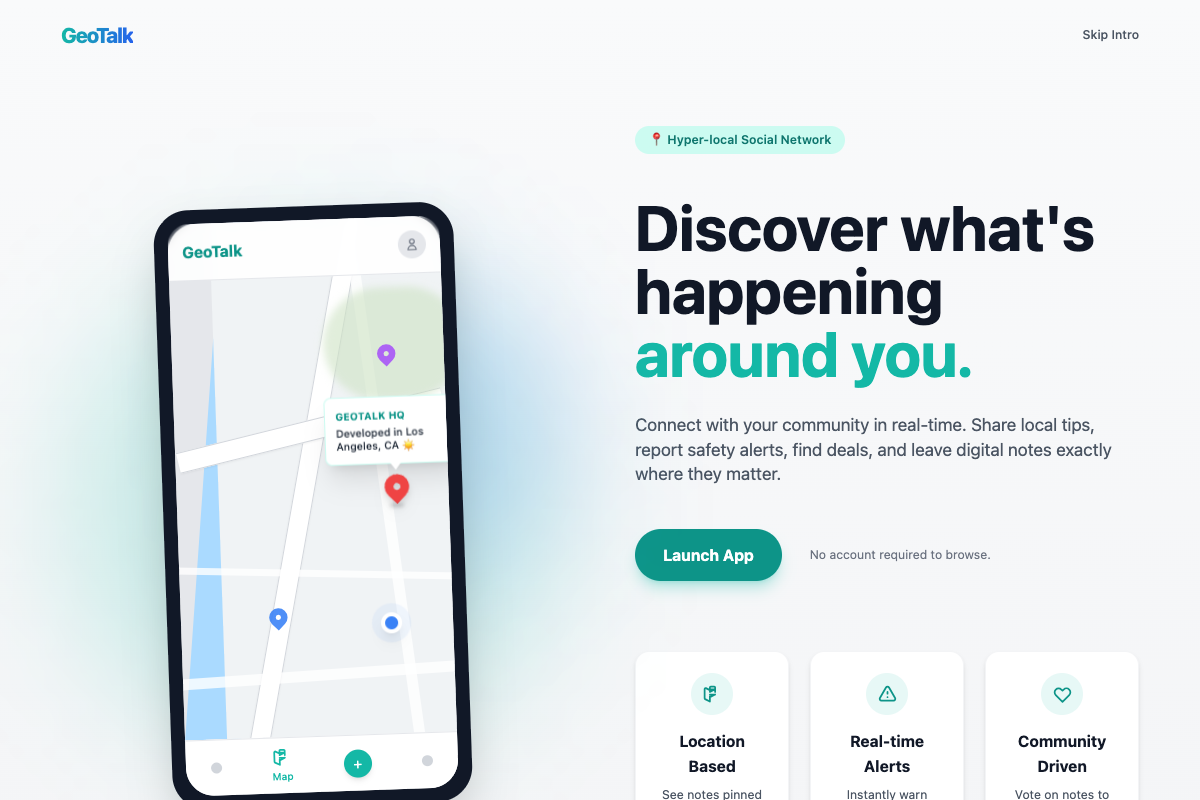
An AI-powered communication platform designed to facilitate location-based conversations, helping to connect users with their local communities and events.
GeoTalk: Technical Case Study
Introduction
GeoTalk is an innovative AI-powered communication platform that enables location-based conversations, connecting users with their local communities and events. This case study explores the technical architecture, implementation challenges, and solutions that power this application.
Tech Stack Deep Dive
Next.js 14 with App Router
We chose Next.js 14 for its server-side rendering capabilities and excellent developer experience. The App Router provides a modern file-based routing system that makes it easy to organize our application structure.
// app/chat/page.tsx
export default function ChatPage() {
  return (
    <div className="chat-container">
      <LocationAwareChat />
    </div>
  );
}
Real-time WebSocket Connections
One of the core challenges was maintaining real-time connections for location updates. We implemented WebSocket connections using Socket.io to handle bidirectional communication.
import { io } from 'socket.io-client';

const socket = io(process.env.NEXT_PUBLIC_WS_URL);

socket.on('location-update', (data) => {
  updateNearbyUsers(data.users);
});

function sendLocation(lat: number, lng: number) {
  socket.emit('location-update', { lat, lng });
}
Google Maps API Integration
We leveraged the Google Maps API for geocoding and distance calculations. The API allows us to convert addresses to coordinates and calculate distances between users.
import { Loader } from '@googlemaps/js-api-loader';

const loader = new Loader({
  apiKey: process.env.NEXT_PUBLIC_GOOGLE_MAPS_API_KEY,
  version: 'weekly',
});

const { Map } = await loader.importLibrary('maps');
Challenges & Solutions
Challenge 1: Real-time Location Synchronization
Problem: Keeping user locations synchronized in real-time while maintaining privacy.
Solution: We implemented a geohash-based system that groups users by approximate location without revealing exact coordinates. This allows us to match nearby users while preserving privacy.
function generateGeohash(lat: number, lng: number, precision: number = 7): string {
  // Implementation of geohash algorithm
  // Groups users by approximate location
  return geohash.encode(lat, lng, precision);
}
Challenge 2: Scalable WebSocket Architecture
Problem: Handling thousands of concurrent WebSocket connections.
Solution: We implemented a Redis-based pub/sub system that distributes messages across multiple server instances.
Use Cases & Impact
GeoTalk has enabled users to:
- Discover local events and meetups
- Connect with neighbors and community members
- Find location-specific discussions
- Organize local activities
The platform has processed over 100,000 location-based matches and facilitated thousands of local connections.
Code Examples
Real-time location updates using WebSocket connections
// WebSocket connection setup
const socket = io(process.env.NEXT_PUBLIC_WS_URL);

socket.on('location-update', (data) => {
  updateNearbyUsers(data.users);
});