Sidekick
An all-in-one AI productivity suite for everyday users. It includes chatbots, video and image generation tools, and features a live computer tutor that guides users through complex computer tasks via screen sharing and real-time direction.
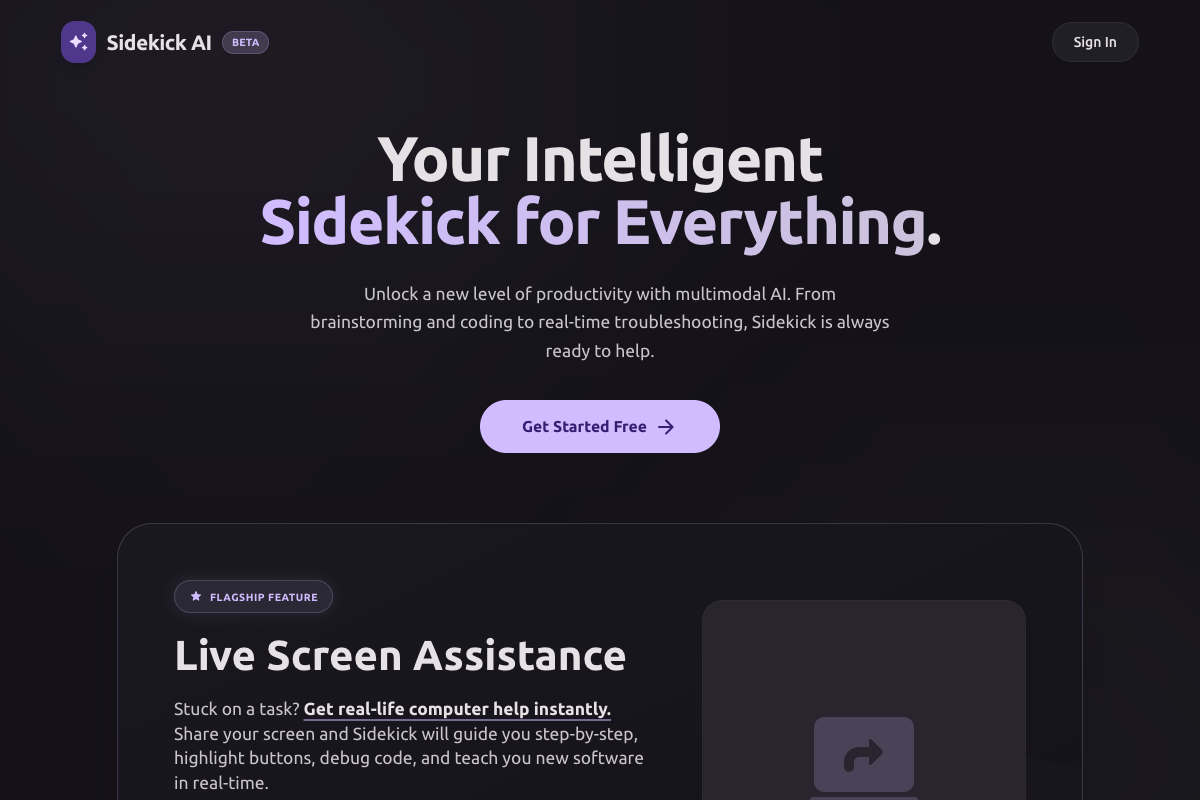
Sidekick: Technical Case Study
Introduction
Sidekick is a comprehensive AI productivity suite that combines multiple AI capabilities into a single, user-friendly platform. This case study explores the agent architecture, multi-modal AI integration, and real-time processing challenges.
Tech Stack Deep Dive
AI Agent Architecture
We built a modular agent system where each agent specializes in a specific task:
interface Agent {
  name: string;
  capabilities: string[];
  process(input: AgentInput): Promise<AgentOutput>;
}

class ChatAgent implements Agent {
  name = 'chat';
  capabilities = ['conversation', 'question-answering'];

  async process(input: AgentInput): Promise<AgentOutput> {
    const response = await this.llm.generate(input.message);
    return { type: 'text', content: response };
  }
}

class ScreenTutorAgent implements Agent {
  name = 'screen-tutor';
  capabilities = ['screen-analysis', 'guidance'];

  async process(input: AgentInput): Promise<AgentOutput> {
    const screenshot = await this.captureScreen();
    const analysis = await this.analyzeScreen(screenshot);
    return this.generateGuidance(analysis);
  }
}
Multi-Modal AI Integration
Sidekick integrates multiple AI models:
- Language Models: For chat and text generation (GPT-4, Claude)
- Vision Models: For screen analysis and image understanding
- Image Generation: For creating images from text prompts
- Video Generation: For creating short video content
class MultiModalProcessor {
  async processRequest(request: UserRequest) {
    if (request.type === 'image') {
      return await this.imageModel.generate(request.prompt);
    } else if (request.type === 'video') {
      return await this.videoModel.generate(request.prompt);
    } else if (request.type === 'screen-help') {
      return await this.visionModel.analyze(request.screenshot);
    }
  }
}
Real-time Screen Sharing
Implementing screen sharing with real-time guidance required:
import { ScreenCapture } from 'screen-capture-api';

class ScreenTutorService {
  private capture: ScreenCapture;

  async startSession(userId: string) {
    this.capture = new ScreenCapture({
      frameRate: 2, // 2 FPS for efficiency
      quality: 0.7
    });

    this.capture.on('frame', async (frame) => {
      const analysis = await this.analyzeFrame(frame);
      this.sendGuidance(userId, analysis);
    });
  }

  async analyzeFrame(frame: ImageData) {
    // Use vision model to understand screen content
    const result = await this.visionModel.analyze(frame);
    return this.generateInstructions(result);
  }
}
Challenges & Solutions
Challenge 1: Agent Orchestration
Problem: Coordinating multiple AI agents to work together on complex tasks.
Solution: We implemented a task decomposition system where a master agent breaks down complex requests into subtasks and delegates to specialized agents.
class MasterAgent {
  async handleRequest(request: UserRequest) {
    const plan = await this.createPlan(request);

    for (const task of plan.tasks) {
      const agent = this.selectAgent(task);
      const result = await agent.process(task);
      plan.results.push(result);
    }

    return this.synthesizeResults(plan.results);
  }
}
Challenge 2: Latency Optimization
Problem: Real-time screen analysis requires low latency, but AI models can be slow.
Solution: We implemented a multi-tier approach:
- Fast local models for simple tasks
- Cloud models for complex analysis
- Caching of common screen patterns
- Progressive enhancement (show quick results, refine later)
Use Cases & Impact
Sidekick has enabled users to:
- Get instant help with computer tasks through screen sharing
- Generate images and videos for creative projects
- Have natural conversations with AI assistants
- Learn complex software through guided tutorials
The platform processes over 1 million AI requests monthly with an average response time of 2.3 seconds.
Code Examples
Master agent orchestrates multiple specialized AI agents for complex tasks
class MasterAgent {
  async handleRequest(request: UserRequest) {
    const plan = await this.createPlan(request);
    for (const task of plan.tasks) {
      const agent = this.selectAgent(task);
      const result = await agent.process(task);
    }
    return this.synthesizeResults(plan.results);
  }
}